A worked practice for your team
Restart a sideline ball together
Agree who last touched a ball that crossed the sideline, then organise a calm ground-pass restart with clear spacing.
ZIP includes the printable coach card, all three SVG diagrams, timeline and practice data. Extract the folder before opening the card.
Check the problem
Players continue after the ball leaves the area, argue over whose turn it is or crowd the person restarting. A predictable routine lets them practise resolving a small decision and then return to the game.
Set up the space and roles
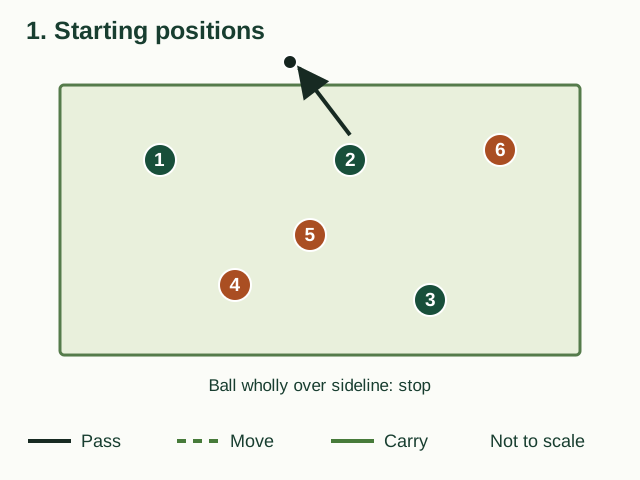
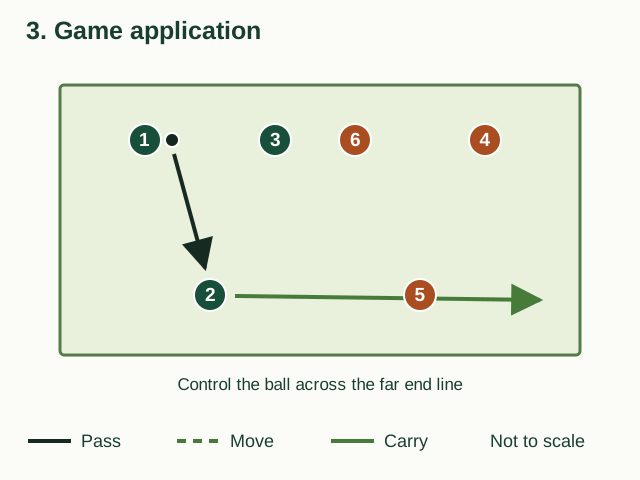
Use four cones for a 20 × 24 m pitch with a 2 m clear buffer outside. Players 1/2/3 face 4/5/6, using one ball and no goalkeepers. Score by carrying under control across the opponents’ end line. For this practice only, a ball wholly over a long sideline is returned by a stationary ground pass from just inside the exit point to the team that did not touch it last. This is a learning rule, not a statement of competition laws.
Keep the rotation clear
Team one takes restarts 1 → 2 → 3; team two 4 → 5 → 6, carrying the order across rounds. Alternate the team starting each round. Everyone plays throughout, so no child becomes a permanent referee or ball retriever.
See the practice in three steps
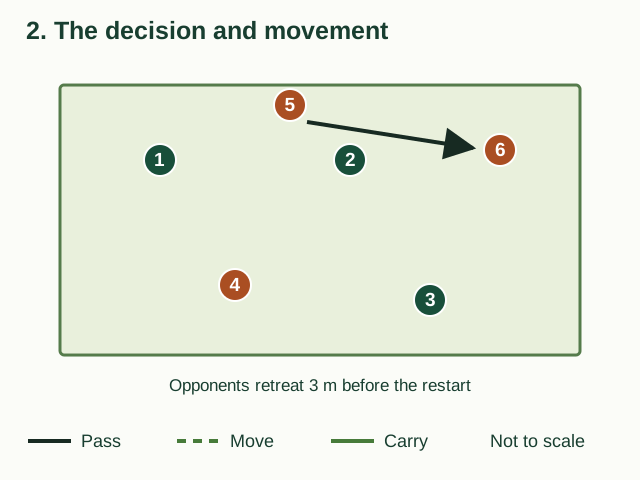
Schematic views, not to scale. Player numbers match the roles below. Dark arrows show passes, dashed green arrows show movement and solid green arrows show carries. Use the written dimensions when marking your area.
1. Starting positions
2. The decision and movement
3. Game application
Your complete 30-minute plan
Briefing, planned role changes, water and reflection are included. Add rest or stop when needed; shorten active play rather than rushing a transition.
00:00–03:00 · 3 min
Check, explain and walk the layout
Walk the sideline with a stationary ball, showing inside, on the line and completely outside. Rehearse stop → identify last touch → give space → restart. Agree that a raised hand can request help; disagreement goes to the supervising adult, who makes the restart decision without a debate.
03:00–08:00 · 5 min
Prepare the movement
In turn, each player gently rolls the ball over the sideline with a foot. The other team identifies its restart taker. Everyone stops before the adult retrieves a ball that has travelled beyond the buffer. Place it still just inside the line; opponents stand at least 3 m away and wait for the ground pass.
08:00–17:00 · 9 min
Focused practice and role changes
Use three rounds of 2 minutes 40 seconds plus 20 seconds of pause. Start with 3v3 and ask players to call a stop when the whole ball crosses a sideline. The conceding player may acknowledge the last touch by voice or gesture. The awarded team chooses its next restart taker in number order. If uncertain, ask the adult once, accept the decision and restart. Defending is limited to ground-pass interceptions with 1 m carrier clearance.
17:00–19:00 · 2 min
Water and reset
Pause for water and check the area. Prepare the 20 × 24 m game area, with 2 m clear outside, reusing the same cones. Extra rest takes priority; shorten the next playing block if needed.
19:00–28:00 · 9 min
Use it in a game
Continue 3v3 for three 2 minute 40 second rounds with 20 second pauses. Let players initiate the sideline routine with fewer adult prompts, while the adult keeps responsibility for safety. End-line scores and other end-line exits give the other team a start from its own end with opponents 3 m back. Sideline restarts still use the agreed local ground-pass rule. Do not reward loud appeals; notice clear acknowledgement and a ready ball.
28:00–30:00 · 2 min
Reflect and choose the next step
Recall one restart that felt clear and fair. If the sequence breaks down, rehearse that step slowly; shorter calm games are more useful here than rushing to finish a score.
Watch for a useful change
- Players stop when the whole ball crosses the sideline.
- The last-touch decision is acknowledged or referred once.
- Opponents give 3 m before the stationary restart.
Make it easier
Have the adult announce only the last-touch decision while players organise the remaining steps.
When ready
Let players complete the whole routine and ask the adult only when uncertain. Keep the same simple restart rule and distances.
Recall one restart that felt clear and fair. If the sequence breaks down, rehearse that step slowly; shorter calm games are more useful here than rushing to finish a score.
Need a different group size or duration?
The worked example above uses the stated numbers. The related complete session has its own checked customizer, maps and rotations.
Open Build from a RestartCoaching principles and further reading
Small-sided play can give children opportunities to take responsibility for simple game decisions.
Public sources reviewed 21 October 2026. Session Pitch created this worked example, timing, role instructions and diagrams; it is not a reproduction of the linked sessions. No FA or FIFA endorsement is implied. Live coaching effectiveness has not been evaluated.