A worked practice for your team
Keep a return route on a narrow pitch
When width is limited, create a safe return option and change the angle before trying to go forward again.
ZIP includes the printable coach card, all three SVG diagrams, timeline and practice data. Extract the folder before opening the card.
Check the problem
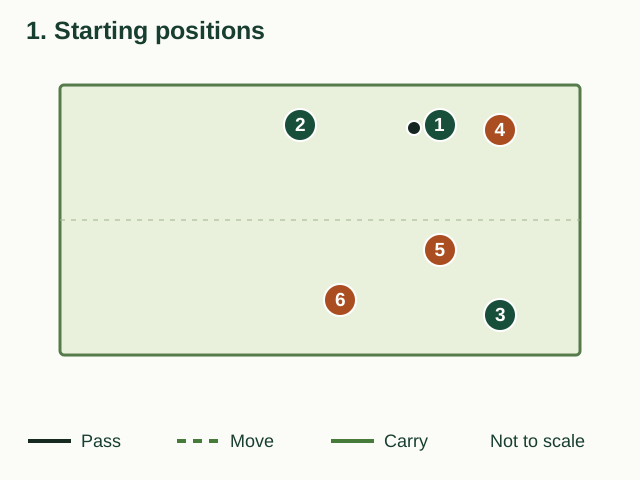
The carrier reaches a crowded side boundary and tries to squeeze a forward pass along it. A teammate stands farther up the same line, so the team has distance but no new angle.
Set up the space and roles
Use a clear 12 × 24 m playing area with a separate 2 m buffer, one ball and eight cones. Four mark the corners and four mark a 3 m end zone at each end. Six players form two teams of three. If the usable area or buffer is smaller, choose another practice instead of packing more players into this example.
Keep the rotation clear
Teams 1/2/3 and 4/5/6 keep all six involved. Starting carriers rotate 1/4, then 2/5, then 3/6. Between rounds swap attacking directions so the same touchline does not always frame the decision.
See the practice in three steps
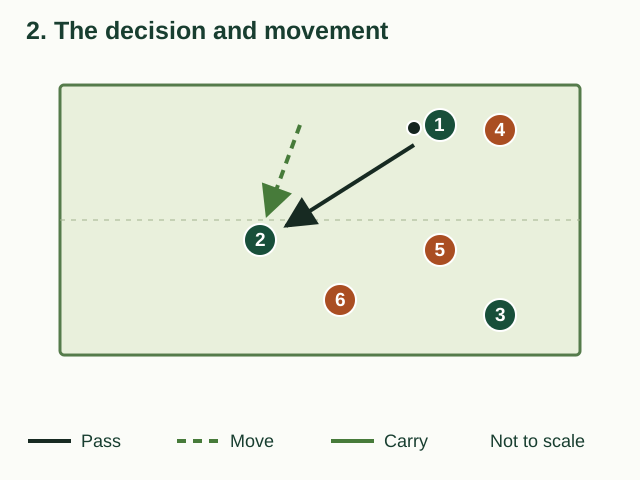
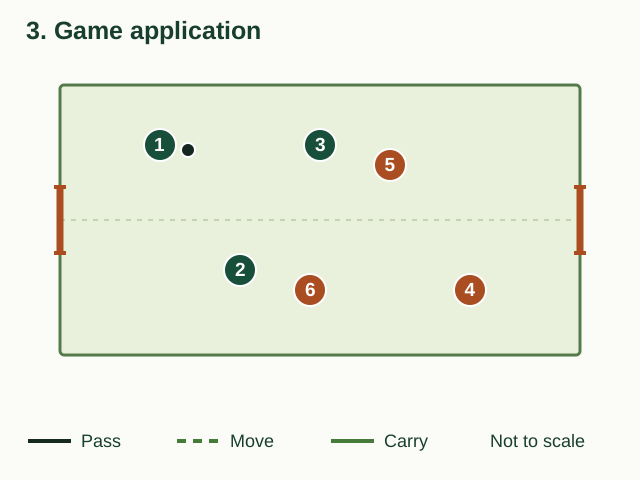
Schematic views, not to scale. Player numbers match the roles below. Dark arrows show passes, dashed green arrows show movement and solid green arrows show carries. Use the written dimensions when marking your area.
1. Starting positions
2. The decision and movement
3. Game application
Your complete 30-minute plan
Briefing, planned role changes, water and reflection are included. Add rest or stop when needed; shorten active play rather than rushing a transition.
00:00–03:00 · 3 min
Check, explain and walk the layout
With play stopped near one side, place one teammate behind and diagonally inside the carrier. Compare that return route with a teammate standing directly ahead on the same boundary line. Keep players and passes inside the playing area.
03:00–08:00 · 5 min
Prepare the movement
One team walks a sequence: carry toward the side, return a gentle ground pass to a supporting teammate, then move inside to offer a new angle. The other team rehearses the positions without a ball. Swap the ball after each sequence so both groups take turns.
08:00–17:00 · 9 min
Focused practice and role changes
Play 3v3 at controlled pace. Pause occasionally when the carrier has no comfortable forward route and ask where a return pass could travel. Use three 2 minute 40 second rounds with 20 second resets; change the starting carrier each time. Defenders protect space or intercept loose ground passes, maintaining a clear gap and no contact.
17:00–19:00 · 2 min
Water and reset
Pause for water and check the playing area. Prepare the 12 × 24 m game area with a clear 2 m outside buffer, reusing the same cones. Extra rest takes priority; shorten the next playing block if needed.
19:00–28:00 · 9 min
Use it in a game
Continue 3v3 with fewer coaching pauses, scoring by a controlled receive in the far end zone. Run three 2 minute 40 second rounds with 20 second breaks. A return pass is an available solution, not a compulsory step. Watch whether it changes the next forward angle rather than repeatedly sending the ball to the same blocked place.
28:00–30:00 · 2 min
Reflect and choose the next step
Ask what the return pass changed. If nothing changed, work on the supporting player’s angle and the next movement; do not demand longer or harder passes in the same narrow route.
Watch for a useful change
- Teammate offers an inside diagonal return route.
- Carrier recognises when forward space is closed.
- Return pass leads to a different next angle.
Make it easier
Pause the defenders while the carrier finds the return option, then restart the picture.
When ready
Remove the pause and let the support move before the carrier reaches the boundary. Keep the area and pace unchanged.
Ask what the return pass changed. If nothing changed, work on the supporting player’s angle and the next movement; do not demand longer or harder passes in the same narrow route.
Need a different group size or duration?
The worked example above uses the stated numbers. The related complete session has its own checked customizer, maps and rotations.
Open Keep or Go ForwardCoaching principles and further reading
The shape of the playing space changes the passing options; a forward pass is not always available.
Public sources reviewed 20 October 2026. Session Pitch created this worked example, timing, role instructions and diagrams; it is not a reproduction of the linked sessions. No FA or FIFA endorsement is implied. Live coaching effectiveness has not been evaluated.