A worked practice for your team
Show readiness with a useful visual signal
Agree a visible readiness signal that helps a passer find a prepared receiver without requiring shouting or eye contact.
ZIP includes the printable coach card, all three SVG diagrams, timeline and practice data. Extract the folder before opening the card.
Check the problem
A player calls loudly from a position where they cannot receive, while another stays available but is overlooked. A signal should communicate readiness and a clear route, not merely draw attention.
Set up the space and roles
Use two 10 × 10 m squares with four cones, a ball and three players in each. Keep a clear 2 m outside buffer and a 4 m gap between squares. Agree one simple signal, such as an open hand pointed toward a receiving space. Speech remains welcome; nobody has to make eye contact or stay silent.
Keep the rotation clear
Players 1, 2 and 3 take turns beginning with the ball; repeat with 4, 5 and 6. The pass changes who is carrier during each round. No player is assigned permanently to observing or signalling.
See the practice in three steps
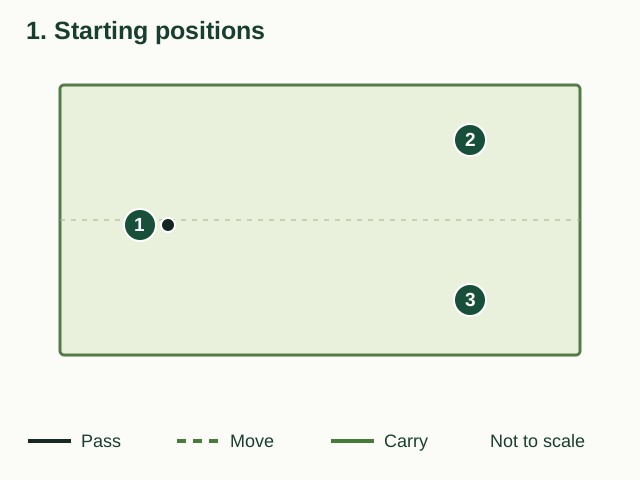
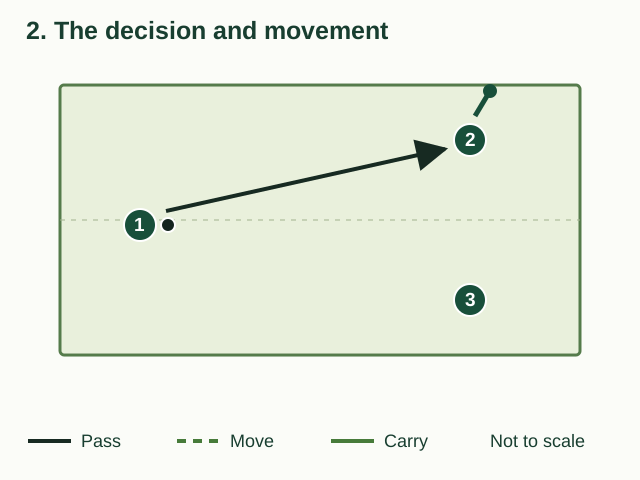
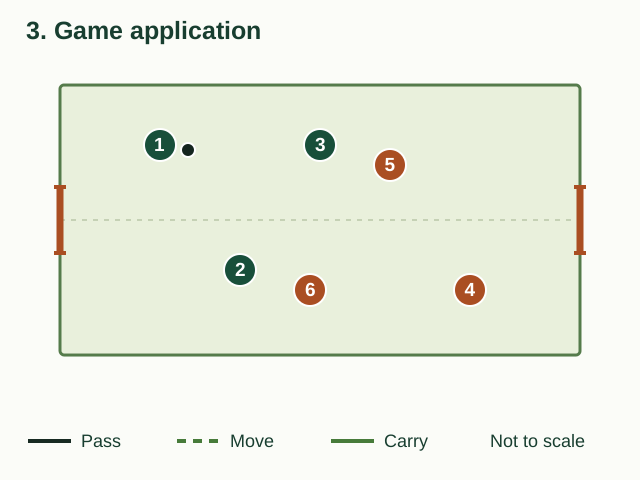
Schematic views, not to scale. Player numbers match the roles below. Dark arrows show passes, dashed green arrows show movement and solid green arrows show carries. Use the written dimensions when marking your area.
1. Starting positions
2. The decision and movement
3. Game application
Your complete 30-minute plan
Briefing, planned role changes, water and reflection are included. Add rest or stop when needed; shorten active play rather than rushing a transition.
00:00–03:00 · 3 min
Check, explain and walk the layout
Ask each player to choose a comfortable way to show readiness. Demonstrate the difference between signalling from a blocked route and moving into view before signalling. Confirm that a raised hand for help or stopping play always takes priority.
03:00–08:00 · 5 min
Prepare the movement
A holds the ball under control while B and C offer different angles. One receiver shows the agreed readiness signal; A checks the lane, passes and moves to support. The new carrier waits for a clear signal before choosing. Keep the pace slow enough to notice both partners.
08:00–17:00 · 9 min
Focused practice and role changes
Both receivers can signal when ready. The carrier chooses the clearer route rather than the louder or earlier signal. Work for 2 minutes 40 seconds and pause for 20 seconds to change the starting carrier; complete three rounds. Ask receivers to lower or change the signal when their route closes so the information stays useful.
17:00–19:00 · 2 min
Water and reset
Pause for water and check the playing area. Prepare the 20 × 25 m game area with a clear 2 m outside buffer, reusing the same cones. Extra rest takes priority; shorten the next playing block if needed.
19:00–28:00 · 9 min
Use it in a game
Play 3v3 on the larger area, scoring by a controlled ground receive across an end line. Use three 2 minute 40 second games with 20 second breaks. Keep all normal speech and stop signals available. Observe whether a gesture helps a player already in a useful space get noticed, rather than turning the game into a silent test.
28:00–30:00 · 2 min
Reflect and choose the next step
Ask which signal was easiest to understand. Keep the one that works for the group rather than judging confidence by volume or requiring one communication style.
Watch for a useful change
- Receiver signals from a usable passing route.
- Passer checks readiness as well as position.
- Signal changes when the receiving route closes.
Make it easier
Use one ready receiver while the third player stays still as a visible alternative, then swap.
When ready
Let receivers move slowly to new angles and update their signal. Keep spoken support available throughout.
Ask which signal was easiest to understand. Keep the one that works for the group rather than judging confidence by volume or requiring one communication style.
Need a different group size or duration?
The worked example above uses the stated numbers. The related complete session has its own checked customizer, maps and rotations.
Open Support the CarrierCoaching principles and further reading
Gestures, positioning and visible movement can add information to spoken communication.
- FIFA Training Centre: non verbal communication
- FIFA Training Centre: collaborate communicate and rotate
Public sources reviewed 20 October 2026. Session Pitch created this worked example, timing, role instructions and diagrams; it is not a reproduction of the linked sessions. No FA or FIFA endorsement is implied. Live coaching effectiveness has not been evaluated.