A worked practice for your team
Settle a rolling ball in a home zone
Help a beginner turn a gentle incoming ground pass into a still, reachable ball before attempting a return.
ZIP includes the printable coach card, all three SVG diagrams, timeline and practice data. Extract the folder before opening the card.
Check the problem
The child swings immediately at every incoming ball, or lets it roll past and runs after it. A returned pass can hide the missing control. Look first for a ball that is still and close enough to use without chasing.
Set up the space and roles
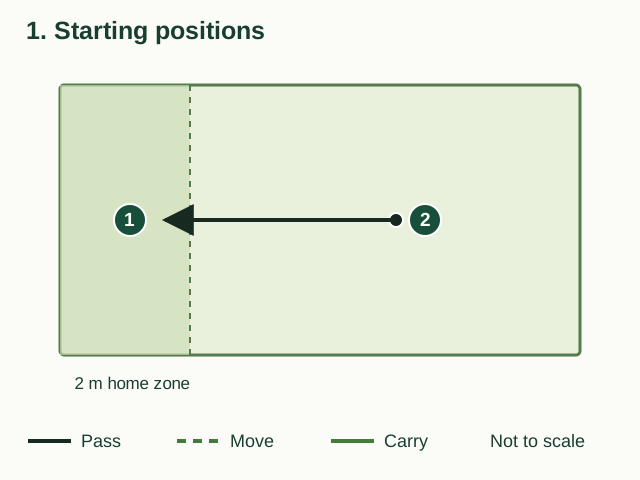
Mark two separate 6 × 8 m rectangles with four corner cones each. Add two cones across each rectangle, 2 m from one short end, to mark a receiving home zone. Use one ball per pair. Leave 4 m between the rectangles and 2 m around the full arrangement: the clear footprint is 20 × 12 m. Player 1 receives in the home zone while 2 passes gently from about 3 m away. Repeat with 3/4. No other ball enters a pair’s area.
Keep the rotation clear
Pair 1/2 and pair 3/4 share receiving and serving after every three attempts, with the lower number receiving first in rounds one and three and the higher number first in round two. No queue or permanent server is needed.
See the practice in three steps
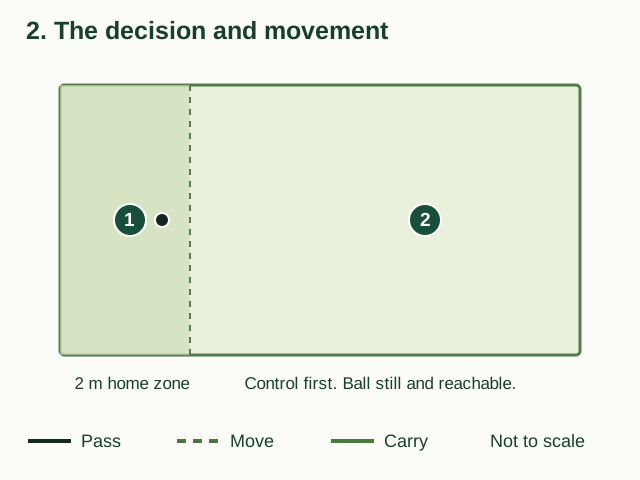
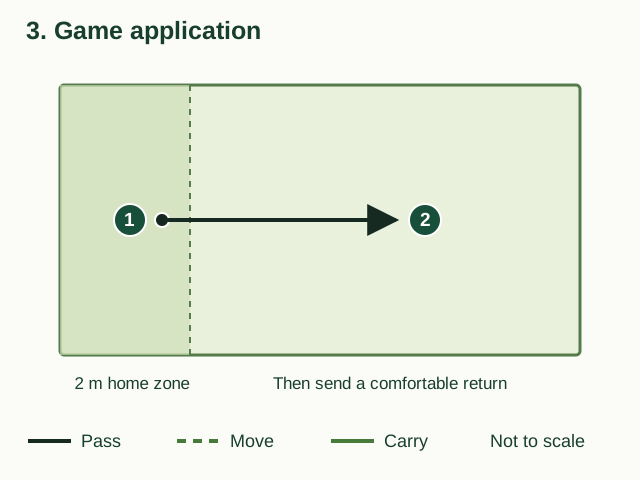
Schematic views, not to scale. Player numbers match the roles below. Dark arrows show passes, dashed green arrows show movement and solid green arrows show carries. Use the written dimensions when marking your area.
1. Starting positions
2. The decision and movement
3. Game application
Your complete 30-minute plan
Briefing, planned role changes, water and reflection are included. Add rest or stop when needed; shorten active play rather than rushing a transition.
00:00–03:00 · 3 min
Check, explain and walk the layout
Check that the surface allows a gentle ball to roll predictably. Demonstrate a slow pass and let the receiver use small comfortable touches to bring it still inside the home zone. Do not require a particular foot surface, a one-touch stop or a quick return. The receiver can ask for a shorter or slower pass.
03:00–08:00 · 5 min
Prepare the movement
Start only 2 m apart. The receiver shows readiness, settles the pass and points to the partner before sending a gentle return. Both players watch the actual ball, keeping their own feet clear of the other child. Stop before retrieving an escaped ball; the adult manages any retrieval beyond the clear buffer. Swap ends after every three attempts.
08:00–17:00 · 9 min
Focused practice and role changes
Use three rounds of 2 minutes 40 seconds followed by 20 seconds of rest. During each round, swap the receiving role after three deliveries. Count a shared success when the ball is still inside the home zone and the receiver can reach the return without an extra chase. There is no required success total. If the ball repeatedly runs through the zone, first shorten the pass or reduce its pace; do not ask the child to stamp on a fast ball.
17:00–19:00 · 2 min
Water and reset
Pause for water and check the area. Keep the same marked areas and their clear outside buffers. Extra rest takes priority; shorten the next playing block if needed.
19:00–28:00 · 9 min
Use it in a game
Keep the two separated pairs for a cooperative game, using the same three round lengths and pauses. One point comes from a settled ball in the home zone followed by a return that the partner can control. After three attempts, both stop and walk around the outside to exchange ends. A missed control simply resets the attempt. Let each receiver request the delivery they can manage. No defender or race is added in this first receiving practice.
28:00–30:00 · 2 min
Reflect and choose the next step
Ask the child to show a ball that is ready to pass back. Repeat the gentle receiving task until the ball can be settled; a longer pass or an opponent is a later choice, not a reward needed today.
Watch for a useful change
- Receiver prepares before the gentle ball arrives.
- Ball becomes still and reachable inside the home zone.
- Return begins after control rather than as an immediate swing.
Make it easier
Move the server closer and use the whole rectangle as the control area. Keep the same slow ground delivery.
When ready
Let the receiver choose a slightly different starting spot inside the home zone. Increase distance only while the incoming ball remains comfortable.
Ask the child to show a ball that is ready to pass back. Repeat the gentle receiving task until the ball can be settled; a longer pass or an opponent is a later choice, not a reward needed today.
Need a different group size or duration?
The worked example above uses the stated numbers. The related complete session has its own checked customizer, maps and rotations.
Open Receive and MoveCoaching principles and further reading
An unopposed receiving task can give beginners time to prepare, control the ball and build confidence before pressure is introduced.
Public sources reviewed 23 October 2026. Session Pitch created this worked example, timing, role instructions and diagrams; it is not a reproduction of the linked sessions. No FA or FIFA endorsement is implied. Live coaching effectiveness has not been evaluated.