A worked practice for your team
Replay an attack after a team timeout
Use one short team timeout to identify a crowded attack, change one supporting position and test the new route immediately.
ZIP includes the printable coach card, all three SVG diagrams, timeline and practice data. Extract the folder before opening the card.
Check the problem
Several players tell the carrier what to do at once while standing in the same lane. Repeated adult instructions may hide whether the team can identify and solve that picture itself.
Set up the space and roles
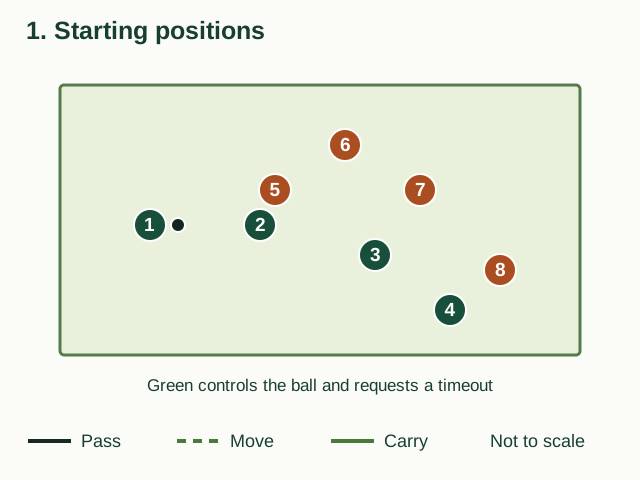
Mark a 24 × 28 m rectangle with four corner cones and a clear 2 m outside buffer. Players 1–4 face 5–8 using one ball. Score by a controlled carry across the opposite end line. Each team has one timeout per round, available only while its carrier has the ball under control. An intercepted or loose ball cannot be reclaimed by calling a timeout.
Keep the rotation clear
Keep teams 1–4 and 5–8. In successive rounds invite 1/5, then 2/6, then 3/7 to suggest a change first; 4/8 begin the final-game sequence. Invitations give everyone a turn without preventing another player from requesting an urgent safety stop. Safety stops never consume the practice timeout.
See the practice in three steps
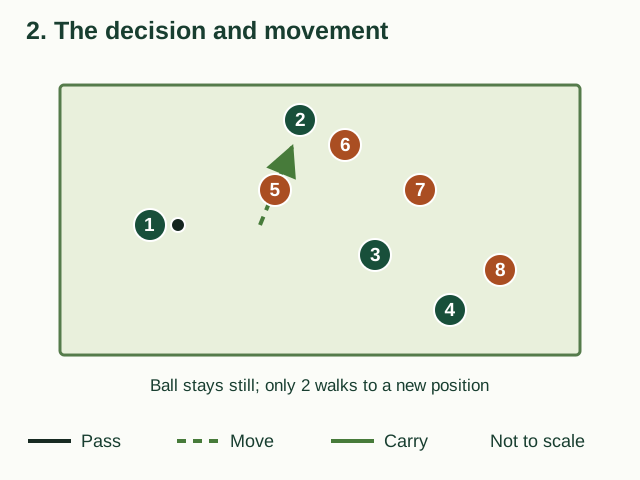
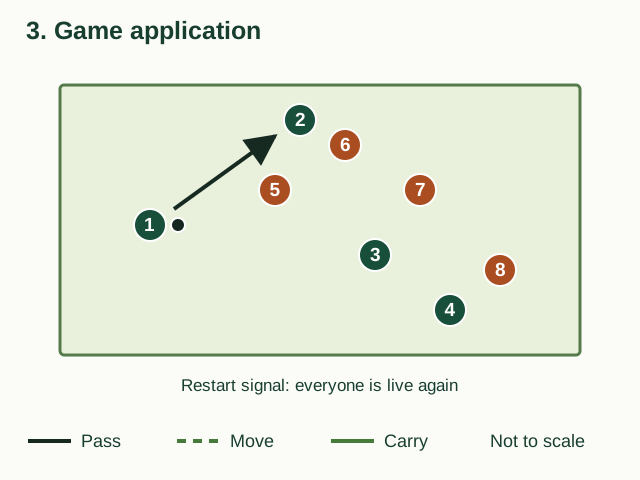
Schematic views, not to scale. Player numbers match the roles below. Dark arrows show passes, dashed green arrows show movement and solid green arrows show carries. Use the written dimensions when marking your area.
1. Starting positions
2. The decision and movement
3. Game application
Your complete 30-minute plan
Briefing, planned role changes, water and reflection are included. Add rest or stop when needed; shorten active play rather than rushing a transition.
00:00–03:00 · 3 min
Check, explain and walk the layout
Demonstrate the routine: a player calls or signals pause; the adult confirms and everyone stops. The carrier leaves the ball still. A teammate identifies one blocked route, and the team chooses one off-ball player to walk to a new position inside the pitch, keeping 2 m from opponents. Defenders hold their positions until the restart. This is a training replay rule.
03:00–08:00 · 5 min
Prepare the movement
Rehearse without opposition pressing. Each team takes a turn showing a crowded picture, naming one change and restarting from the same ball position. Swap the child who proposes the change on the next rehearsal. Suggestions can be spoken or indicated by pointing; do not require every player to give a speech.
08:00–17:00 · 9 min
Focused practice and role changes
Play three rounds of 2 minutes 40 seconds plus 20 seconds of rest. Each team may use one confirmed timeout within the playing time. Allow up to 20 seconds to agree and walk the single change; if agreement takes longer, the adult offers two simple positions and resumes calmly. After a clear restart signal both teams are live immediately. Defenders intercept ground passes and maintain 1 m from carriers. The timeout does not protect the following pass from interception.
17:00–19:00 · 2 min
Water and reset
Pause for water and check the area. Prepare the 24 × 28 m game area, with 2 m clear outside, reusing the same cones. Extra rest takes priority; shorten the next playing block if needed.
19:00–28:00 · 9 min
Use it in a game
Play the same three round lengths, keeping the one-timeout rule. Encourage a different teammate to request and propose each round’s change. After the replay, wait until the next natural stop to ask whether the new route was usable. A score or ball out gives the other team a restart at its own end with opponents 3 m away; this does not restore a used timeout. Teams can also choose not to use their timeout.
28:00–30:00 · 2 min
Reflect and choose the next step
Compare the route before and after the change, even if the pass failed. If the new route was useful but execution failed, repeat the pass; if the route stayed blocked, revisit the chosen position.
Watch for a useful change
- Timeout is requested while the ball is controlled.
- The team changes one identifiable supporting position.
- Players can say whether the replay opened a usable route.
Make it easier
The adult freezes one clear crowded picture and lets the team choose between two possible support positions.
When ready
Let the team identify the picture and propose the position without suggested options. Keep the single change and stationary ball.
Compare the route before and after the change, even if the pass failed. If the new route was useful but execution failed, repeat the pass; if the route stayed blocked, revisit the chosen position.
Need a different group size or duration?
The worked example above uses the stated numbers. The related complete session has its own checked customizer, maps and rotations.
Open Team Decisions FestivalCoaching principles and further reading
Giving players room to propose a solution can make a small-sided challenge more collaborative.
Public sources reviewed 21 October 2026. Session Pitch created this worked example, timing, role instructions and diagrams; it is not a reproduction of the linked sessions. No FA or FIFA endorsement is implied. Live coaching effectiveness has not been evaluated.