A worked practice for your team
Receive your return pass beyond a screen
Coordinate the original passer and a wall player so a return pass reaches the far side of a stationary screen.
ZIP includes the printable coach card, all three SVG diagrams, timeline and practice data. Extract the folder before opening the card.
Check the problem
The passer watches the ball after releasing it. The wall player then returns to the old position, leaving both players on the same side of the screen. Look for a new receiving destination before asking for a faster combination.
Set up the space and roles
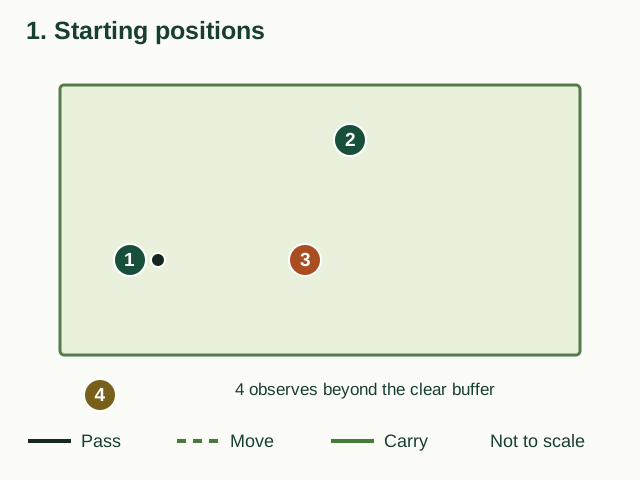
Mark two 12 × 16 m rectangles with four cones each, leaving 2 m clear around each and a 4 m gap between them. Each quartet has one ball. Player 1 begins near one end, 2 offers a wide wall pass, 3 is a stationary screen and 4 observes outside the rectangle. The runner travels around the screen with at least 2 m clearance. No player challenges for the ball in this block.
Keep the rotation clear
First quartet: 1 runner, 2 wall, 3 screen, 4 observer; rotate runner → wall → screen → observer → runner. Repeat with 5–8. Final teams are 1/2/5/6 against 3/4/7/8; alternate starting possession each round.
See the practice in three steps
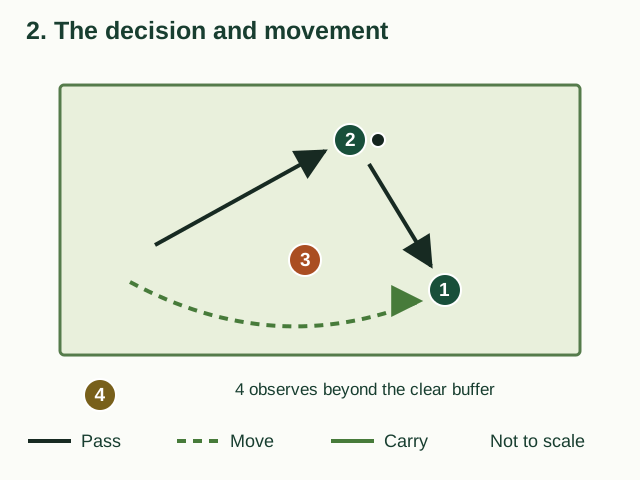
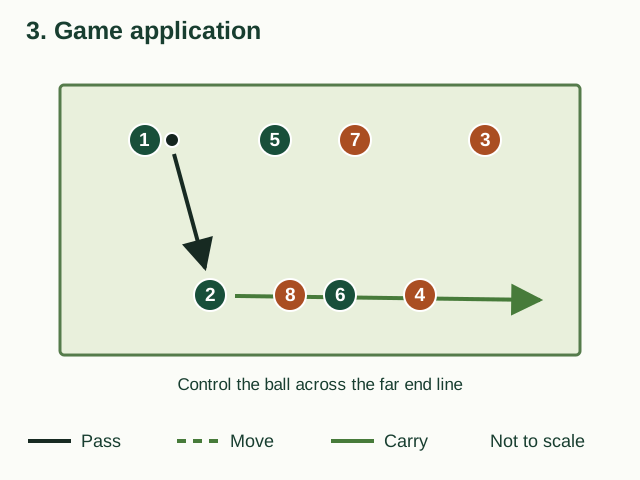
Schematic views, not to scale. Player numbers match the roles below. Dark arrows show passes, dashed green arrows show movement and solid green arrows show carries. Use the written dimensions when marking your area.
1. Starting positions
2. The decision and movement
3. Game application
Your complete 30-minute plan
Briefing, planned role changes, water and reflection are included. Add rest or stop when needed; shorten active play rather than rushing a transition.
00:00–03:00 · 3 min
Check, explain and walk the layout
Walk the sequence without a ball. Player 1 points to the space beyond 3, passes an imaginary ball to 2 and curves into that space. Player 2 identifies where the return should arrive. Agree to cancel a pass if the runner is not ready.
03:00–08:00 · 5 min
Prepare the movement
Use gentle ground passes. Player 2 takes a settling touch before returning to 1, who stops to receive beyond the screen. Reset at walking pace after each attempt and change starter after two attempts. The observer checks the receiving position and keeps clear of the return lane.
08:00–17:00 · 9 min
Focused practice and role changes
Spend 1 minute demonstrating, then run four cycles of 1 minute 40 seconds of practice and 20 seconds of role change. Let 1 keep moving at walking pace for the return. Player 2 delays delivery until the runner clears the screen. Reset after a missed pass; do not chase through the screen. Rotate all four roles each cycle so everyone sees the same problem from both passing positions.
17:00–19:00 · 2 min
Water and reset
Pause for water and check the area. Prepare the 24 × 28 m game area, with 2 m clear outside, reusing the same cones. Extra rest takes priority; shorten the next playing block if needed.
19:00–28:00 · 9 min
Use it in a game
Join for 4v4. Score one point by controlling a carry across the opponents’ end line; award one extra point if that attack includes a completed give-and-go to the original passer beyond an opponent. The extra point is optional, so an open carry remains useful. Play three rounds of 2 minutes 40 seconds plus 20 seconds to reset. Defenders may intercept ground passes but keep a 1 m gap from carriers. After a score or ball out, the other team starts from its end line while opponents retreat 3 m.
28:00–30:00 · 2 min
Reflect and choose the next step
Ask the wall player what made the return possible. If the ball goes back to the old position, repeat the walk-through; count a useful new receiving position before counting successful combinations.
Watch for a useful change
- Original passer names or shows a new receiving destination.
- Wall player waits until the route beyond the screen is open.
- Return is controlled without the runner cutting close to another player.
Make it easier
Keep the runner still beyond the screen before returning the ball. Shorten the two passes if control is unreliable.
When ready
Let the wall player choose whether the return route is clear or a reset is preferable. Keep the screen still and the clearance unchanged.
Ask the wall player what made the return possible. If the ball goes back to the old position, repeat the walk-through; count a useful new receiving position before counting successful combinations.
Need a different group size or duration?
The worked example above uses the stated numbers. The related complete session has its own checked customizer, maps and rotations.
Open Return Around the CornerCoaching principles and further reading
Moving after a pass can create an opportunity to receive again in a new position.
Public sources reviewed 21 October 2026. Session Pitch created this worked example, timing, role instructions and diagrams; it is not a reproduction of the linked sessions. No FA or FIFA endorsement is implied. Live coaching effectiveness has not been evaluated.