A worked practice for your team
Make the first connection after an interception
After intercepting a ground pass, secure the ball and connect with a teammate instead of clearing it without looking.
ZIP includes the printable coach card, all three SVG diagrams, timeline and practice data. Extract the folder before opening the card.
Check the problem
A successful interception is immediately kicked away or lost because the partner remains in a defending position. Check both the interceptor’s control and the teammate’s response to the new possession.
Set up the space and roles
Create two 12 × 16 m areas with four corner cones, one ball and four players each. Two players begin as attackers and two as defenders. Keep a 2 m clear buffer around each area and 4 m between them. Interceptions are of loose ground passes only; there is no tackling, chasing through bodies or contact.
Keep the rotation clear
Swap attacking and defending pairs after each short focused round; within the defending pair alternate who starts nearer the passing lane. All players experience interception, support and the old attacking roles.
See the practice in three steps
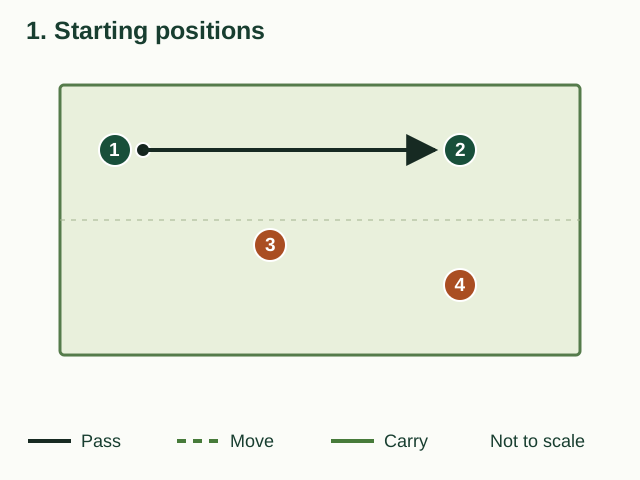
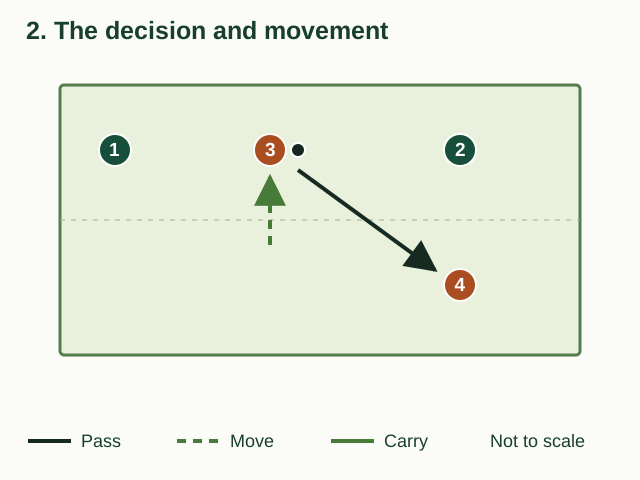
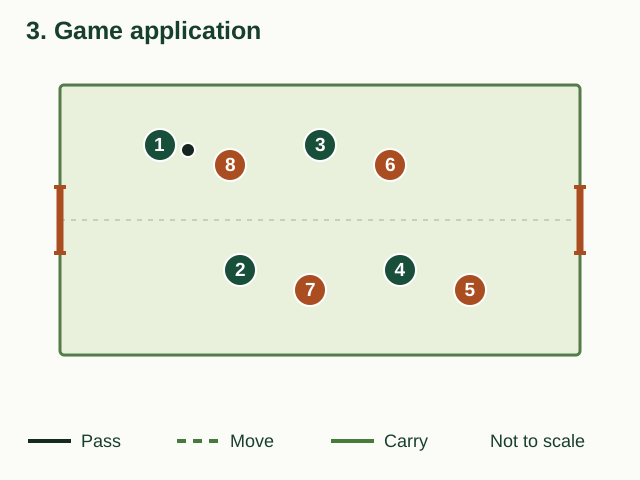
Schematic views, not to scale. Player numbers match the roles below. Dark arrows show passes, dashed green arrows show movement and solid green arrows show carries. Use the written dimensions when marking your area.
1. Starting positions
2. The decision and movement
3. Game application
Your complete 30-minute plan
Briefing, planned role changes, water and reflection are included. Add rest or stop when needed; shorten active play rather than rushing a transition.
00:00–03:00 · 3 min
Check, explain and walk the layout
A gently passes toward B while C intercepts from a safe clear lane. Pause on C’s first controlled touch. D now moves from cover into a visible supporting angle. This is a scripted demonstration; A and B stop while the new pair connects.
03:00–08:00 · 5 min
Prepare the movement
Repeat the gentle interception and C-to-D pass without pressure. D offers space away from the old passing lane. The interceptor can use more than one touch. Reset once D controls the ball, and change the interceptor after every two attempts.
08:00–17:00 · 9 min
Focused practice and role changes
Allow A and B to choose one of two ground passing routes. C and D may intercept a loose pass, maintaining distance from the carriers. After a regain, the old attackers pause for a count of three so the new pair can control and connect. Use 1 minute to explain and four rounds of 1 minute 40 seconds plus 20 seconds to change pairs. This pause is a practice aid, not a match rule.
17:00–19:00 · 2 min
Water and reset
Pause for water and check the playing area. Prepare the 24 × 28 m game area with a clear 2 m outside buffer, reusing the same cones. Extra rest takes priority; shorten the next playing block if needed.
19:00–28:00 · 9 min
Use it in a game
Play 4v4 in the larger area, scoring by a controlled end-line carry. Use three 2 minute 40 second rounds and 20 second resets. Keep the three-count pause after a regain in round one; remove it only if control and support remain comfortable. Observe the first connection rather than rewarding the hardest clearance.
28:00–30:00 · 2 min
Reflect and choose the next step
Separate a poor first touch from missing support. Repeat the unpressured connection if control is the issue; pause the role change if the teammate stays behind in a defending position.
Watch for a useful change
- Interceptor controls before choosing the next action.
- Partner changes from cover to a visible support angle.
- First pass stays usable rather than being kicked away.
Make it easier
Keep the interception scripted and let the partner settle before the pass.
When ready
Remove the old attackers’ pause while keeping no-contact defending; retain it if players rush and lose control.
Separate a poor first touch from missing support. Repeat the unpressured connection if control is the issue; pause the role change if the teammate stays behind in a defending position.
Need a different group size or duration?
The worked example above uses the stated numbers. The related complete session has its own checked customizer, maps and rotations.
Open Win It and Use ItCoaching principles and further reading
A regain changes the team’s task; players need a useful option for the next action.
- FIFA Training Centre: using the numerical advantage
- FIFA Training Centre: collaborate communicate and rotate
Public sources reviewed 20 October 2026. Session Pitch created this worked example, timing, role instructions and diagrams; it is not a reproduction of the linked sessions. No FA or FIFA endorsement is implied. Live coaching effectiveness has not been evaluated.