A worked practice for your team
Disguise a pass in a five-player square
Use a small body-shape feint to move a walking screen, then check and pass along a genuinely open route.
ZIP includes the printable coach card, all three SVG diagrams, timeline and practice data. Extract the folder before opening the card.
Check the problem
The passer points their whole body toward one teammate and the screen blocks that route early. Alternatively, the child tries to look away while kicking and misses the actual receiver. Separate a brief feint from the final look at the intended pass.
Set up the space and roles
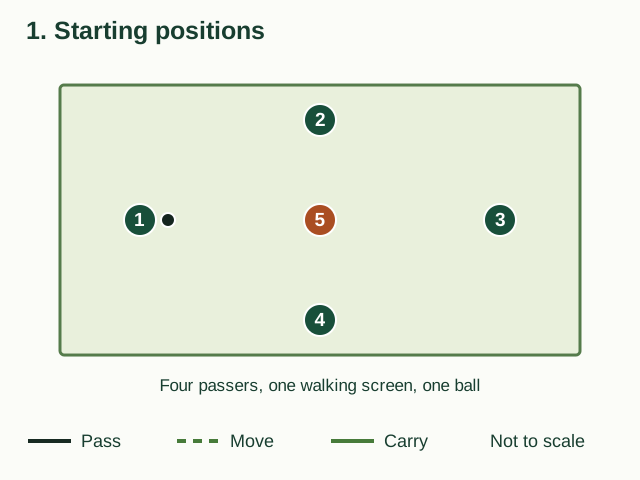
Use four cones for a 12 × 12 m square, with 2 m clear outside: the full clear footprint is 16 × 16 m. Four passers stand inside the square near its sides, with one screen centrally. Use one ball. The screen walks to protect passing lanes, stays at least 2 m from the carrier and intercepts ground passes only. The other four may move along their side to become available; nobody is fixed on a cone.
Keep the rotation clear
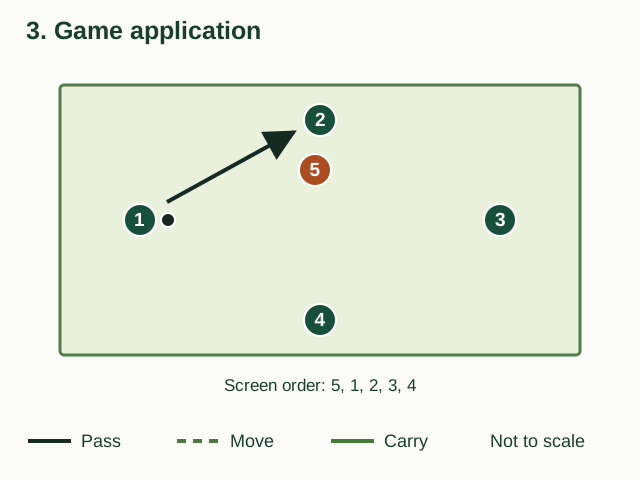
Screen order is 5 → 1 → 2 → 3 → 4 in both timed blocks; the outgoing screen takes the incoming screen’s side. Every player screens once in each block and passes in the other four cycles. This planned swap does not depend on who made a mistake.
See the practice in three steps
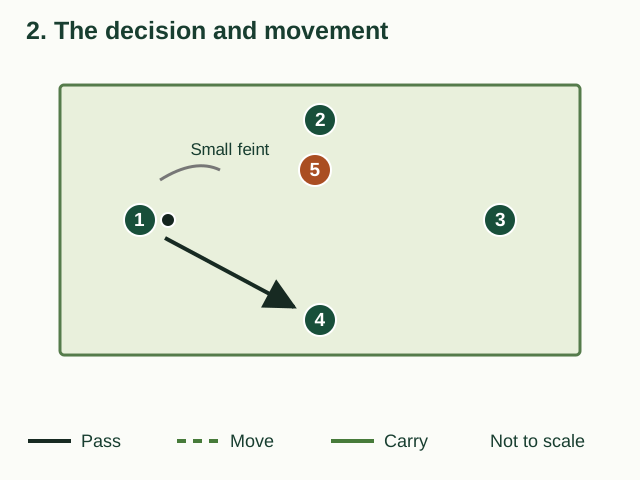
Schematic views, not to scale. Player numbers match the roles below. Dark arrows show passes, dashed green arrows show movement and solid green arrows show carries. Use the written dimensions when marking your area.
1. Starting positions
2. The decision and movement
3. Game application
Your complete 30-minute plan
Briefing, planned role changes, water and reflection are included. Add rest or stop when needed; shorten active play rather than rushing a transition.
00:00–03:00 · 3 min
Check, explain and walk the layout
With the ball still, show a small turn of the shoulders toward one route, then turn back, look at the actual receiver and make a gentle pass through the open lane. Explain that deception is optional. A clear direct pass is useful too; the feint must not become a blind kick.
03:00–08:00 · 5 min
Prepare the movement
Let the screen stand still. Passers explore a settling touch, a small body-shape change and a checked ground pass. Ask the receiver to show readiness before delivery. Pause after a misdirected pass and compare the feint with the final checked route. No first-time passing or repeated fast foot movement is required.
08:00–18:00 · 10 min
Focused practice and role changes
Use the 10-minute block for five cycles of 1 minute 40 seconds of play plus 20 seconds to change the screen. The screen may walk before the pass. Passers look for an available route and can use one small feint when the screen has committed to a lane. A controlled pass earns one shared point; a feint earns no separate bonus. After an interception or ball out, stop and restart with a different passer, keeping the same screen until the timed change.
18:00–20:00 · 2 min
Water and reset
Pause for water and check the area. Keep the same marked areas and their clear outside buffers. Extra rest takes priority; shorten the next playing block if needed.
20:00–28:00 · 8 min
Use it in a game
The final 8-minute block begins with 30 seconds to reset, followed by five cycles of 1 minute 10 seconds of play plus 20 seconds to change screen. Try to complete three consecutive passes for a shared point, then stop and restart with a new passer. Reset the count after an interception or ball out. Keep the same walking screen and 2 m carrier gap. Notice whether players choose a simple pass when available and use deception only when it changes the lane.
28:00–30:00 · 2 min
Reflect and choose the next step
Ask whether the feint opened a new lane. If it did not, a direct pass or another settling touch may be better. Repeat slowly whenever the final check disappears.
Watch for a useful change
- Passer checks the actual receiver after the feint.
- The body-shape change affects the screened lane.
- Players use an open direct pass without unnecessary extra movement.
Make it easier
Keep the screen still and demonstrate the feint without a ball before adding the gentle pass.
When ready
Let the screen make one walking adjustment after the feint. Keep unrestricted touches and the same gap; cancel the pass if the route closes.
Ask whether the feint opened a new lane. If it did not, a direct pass or another settling touch may be better. Repeat slowly whenever the final check disappears.
Need a different group size or duration?
The worked example above uses the stated numbers. The related complete session has its own checked customizer, maps and rotations.
Open Passing TriangleCoaching principles and further reading
A small passing game can invite players to explore how body shape disguises a pass while teammates remain available.
Public sources reviewed 23 October 2026. Session Pitch created this worked example, timing, role instructions and diagrams; it is not a reproduction of the linked sessions. No FA or FIFA endorsement is implied. Live coaching effectiveness has not been evaluated.