A worked practice for your team
Defend the opponents’ current objective
Adjust defending when one team scores through consecutive passes and the other scores through either end-line gate.
ZIP includes the printable coach card, all three SVG diagrams, timeline and practice data. Extract the folder before opening the card.
Check the problem
Defenders protect an empty goal while the opponents earn points through uncontested passes, or chase passes while leaving a scoring gate unprotected. The useful position depends on the opponents’ task.
Set up the space and roles
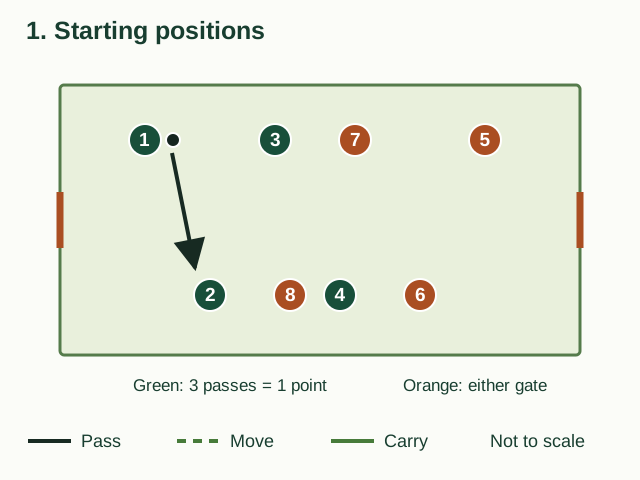
Use four cones for a 24 × 28 m pitch and four more for one 3 m gate on each short end line. Leave a 2 m clear outer buffer. Players 1–4 form Green and 5–8 Orange. One ball is shared. During the focused game, the keeping team earns a point for three consecutive completed passes; the attacking team earns a point for a controlled ground carry through either gate. No goalkeepers are needed.
Keep the rotation clear
Keep the same four-player teams so the scoring task is the changing factor. Alternate the player taking each restart, in number order within the team. Both teams have equal focused time keeping and attacking; nobody is assigned as a permanent gate guard.
See the practice in three steps
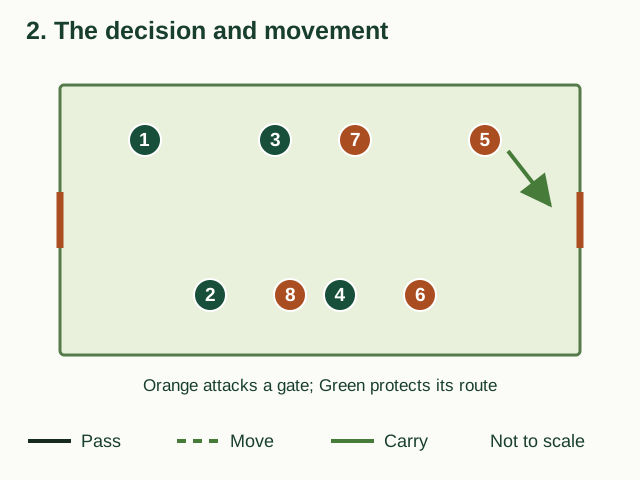
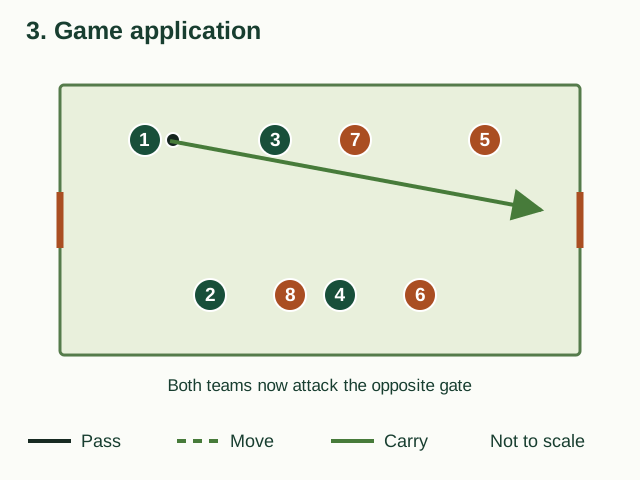
Schematic views, not to scale. Player numbers match the roles below. Dark arrows show passes, dashed green arrows show movement and solid green arrows show carries. Use the written dimensions when marking your area.
1. Starting positions
2. The decision and movement
3. Game application
Your complete 30-minute plan
Briefing, planned role changes, water and reflection are included. Add rest or stop when needed; shorten active play rather than rushing a transition.
00:00–03:00 · 3 min
Check, explain and walk the layout
Show both scoring methods at walking pace. Before restarting, ask each team to state how the other team earns a point. Explain that protecting a gate and stopping a passing sequence can call for different positions.
03:00–08:00 · 5 min
Prepare the movement
Give each team two short unopposed possessions while the other watches from outside the area. Rehearse three controlled passes, then a carry through a gate. Alternate demonstrations and keep the ball still while teams enter or leave. Observers identify where they might stand to interrupt each task.
08:00–17:00 · 9 min
Focused practice and role changes
Spend 1 minute confirming the rules, then play four rounds of 1 minute 40 seconds plus 20 seconds to swap objectives. Green keeps in rounds one and three; Orange keeps in two and four. After a point or ball out, the other team restarts from the middle with opponents 3 m away; its own scoring objective applies. Interception starts live possession for the intercepting team. Passing counts restart after each point, loss or ball out. Defenders protect routes and intercept ground passes without approaching within 1 m of the carrier.
17:00–19:00 · 2 min
Water and reset
Pause for water and check the area. Prepare the 24 × 28 m game area, with 2 m clear outside, reusing the same cones. Extra rest takes priority; shorten the next playing block if needed.
19:00–28:00 · 9 min
Use it in a game
Now both teams attack the opposite end-line gate, earning one point for a controlled carry through it. Play three rounds of 2 minutes 40 seconds plus 20 seconds to breathe and swap ends. After a score or ball out, the other team starts at its own end with a 3 m retreat. Ask players to notice that the opponents’ target is now fixed; do their defensive positions change accordingly?
28:00–30:00 · 2 min
Reflect and choose the next step
Choose one defensive position that helped against passes and one that helped against a gate. If players cannot explain the difference, repeat only one objective at a time before combining them again.
Watch for a useful change
- Defenders can describe the current opponent objective.
- Position changes when the scoring task changes.
- Restarting players use the correct task after a point or interception.
Make it easier
Use four passes for the keeping task and pause at role changes to point out the relevant target. Keep the defending gap.
When ready
Keep the scoring rules unchanged but remove coach reminders during the round. Let teammates correct the objective together at the next stop.
Choose one defensive position that helped against passes and one that helped against a gate. If players cannot explain the difference, repeat only one objective at a time before combining them again.
Need a different group size or duration?
The worked example above uses the stated numbers. The related complete session has its own checked customizer, maps and rotations.
Open Keep or Go ForwardCoaching principles and further reading
Different scoring objectives can draw attention to the contrast between keeping the ball and creating a scoring opportunity.
Public sources reviewed 21 October 2026. Session Pitch created this worked example, timing, role instructions and diagrams; it is not a reproduction of the linked sessions. No FA or FIFA endorsement is implied. Live coaching effectiveness has not been evaluated.