A worked practice for your team
Build a pass with the less-used foot
Give each player a low-pressure way to attempt, judge and repeat a short ground pass with their less-used foot.
ZIP includes the printable coach card, all three SVG diagrams, timeline and practice data. Extract the folder before opening the card.
Check the problem
A player always turns the ball onto the same foot, even when trying a short unopposed pass. A demand to use the other foot during a crowded game may produce a hurried swing. Separate the technical attempt from the pressure of keeping possession.
Set up the space and roles
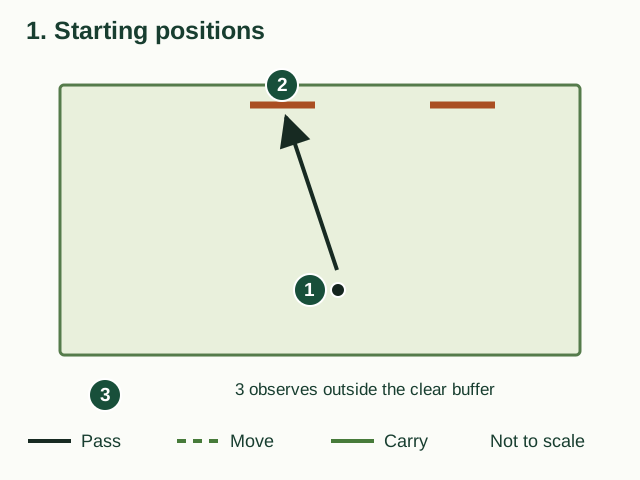
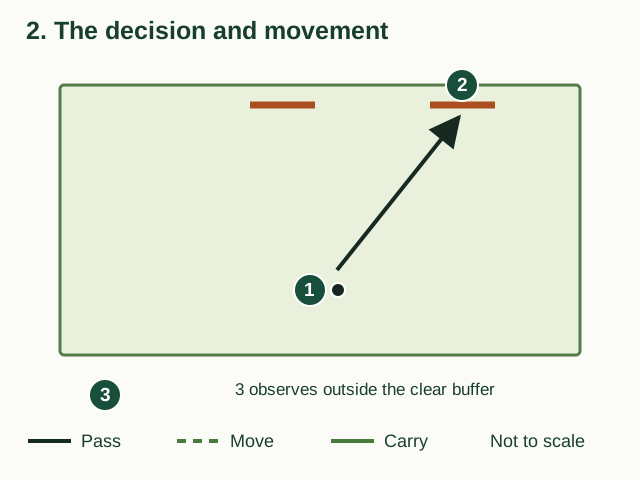
Make two 8 × 10 m rectangles with four corner cones each. Inside the far end of each, use four more cones for two 2 m wide receiving gates, one left and one right, kept at least 2 m apart. Leave 2 m clear outside each area and 4 m between neighbours. Player 1 passes from 3 m away, 2 receives beyond the chosen gate and 3 waits outside the clear buffer to observe and then join the next role. Each trio shares one ball.
Keep the rotation clear
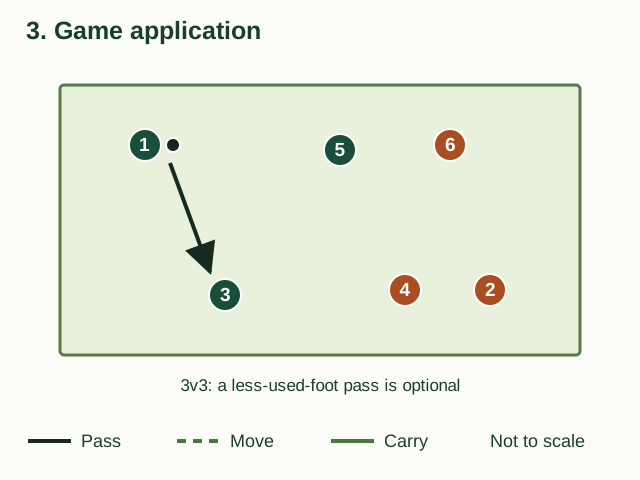
Use 1/2/3 and 4/5/6 in the two trios. All players get one complete round in each focused role. Final teams are 1/3/5 against 2/4/6; alternate the starting team and restart taker each round.
See the practice in three steps
Schematic views, not to scale. Player numbers match the roles below. Dark arrows show passes, dashed green arrows show movement and solid green arrows show carries. Use the written dimensions when marking your area.
1. Starting positions
2. The decision and movement
3. Game application
Your complete 30-minute plan
Briefing, planned role changes, water and reflection are included. Add rest or stop when needed; shorten active play rather than rushing a transition.
00:00–03:00 · 3 min
Check, explain and walk the layout
Ask each player which foot they use less for a short pass. Invite a comfortable attempt with that foot, without forcing it if the movement causes discomfort. Show that a settling touch and a pause are allowed before passing. The target is a controllable ground delivery, not power or a rigid body pose.
03:00–08:00 · 5 min
Prepare the movement
Use the familiar foot first to agree a comfortable distance. The receiver settles the ball beyond one gate and returns it by a clear route. Change roles after three deliveries. The observer describes whether the receiver could control the ball without leaving the area, rather than judging how the passer’s movement looked.
08:00–17:00 · 9 min
Focused practice and role changes
Play three rounds of 2 minutes 40 seconds and use 20 seconds to rotate passer → receiver → observer → passer. The passer can use any settling touches, then attempt the ground pass with the less-used foot. The receiver chooses a gate and stands ready before the pass. Alternate comfortable familiar-foot and less-used-foot attempts if the child needs a comparison. After a miss, shorten the distance and try again; do not add a first-time requirement or a narrow target.
17:00–19:00 · 2 min
Water and reset
Pause for water and check the area. Prepare the 20 × 24 m game area, reusing the cones and leaving 2 m clear outside. Extra rest takes priority; shorten the next playing block if needed.
19:00–28:00 · 9 min
Use it in a game
Join for 3v3, scoring one point for a controlled carry across the far end line. An attack can earn one optional extra point if it includes a less-used-foot pass that a teammate controls. Nobody has to choose that foot under pressure. Play three rounds of 2 minutes 40 seconds plus 20 seconds of pause. Defenders intercept ground passes only and stay 1 m from carriers. After a score or ball out, the other team restarts from its own end with opponents 3 m away.
28:00–30:00 · 2 min
Reflect and choose the next step
Ask which attempt felt controllable and what adjustment helped. Repeat at a manageable distance before expecting the less-used foot to appear during a competitive game.
Watch for a useful change
- Player can identify the foot they are practising.
- Pass remains on the ground and reaches a ready receiver.
- Player adjusts distance or settles the ball rather than rushing a harder swing.
Make it easier
Use a 2 m pass to a still partner without gates. Let the player compare one comfortable attempt with either foot.
When ready
Keep the same short distance but let the receiver choose between the two gates before the passer settles the ball. Preserve time to prepare.
Ask which attempt felt controllable and what adjustment helped. Repeat at a manageable distance before expecting the less-used foot to appear during a competitive game.
Need a different group size or duration?
The worked example above uses the stated numbers. The related complete session has its own checked customizer, maps and rotations.
Open Pass Through GatesCoaching principles and further reading
Passing activities can invite players to explore different parts of the foot and practise a foot they use less often.
Public sources reviewed 23 October 2026. Session Pitch created this worked example, timing, role instructions and diagrams; it is not a reproduction of the linked sessions. No FA or FIFA endorsement is implied. Live coaching effectiveness has not been evaluated.